
This page really is a hotch-potch of items that don’t easily fit in anywhere else. Many are to do with drawing curves, such as the ellipsograph and French curves. Others are for perspective drawing such as the centrolinead and camera lucida. The opisometer is for measuring the length of curved lines.

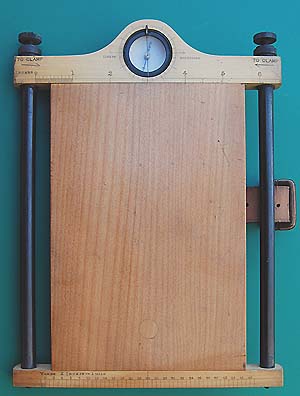
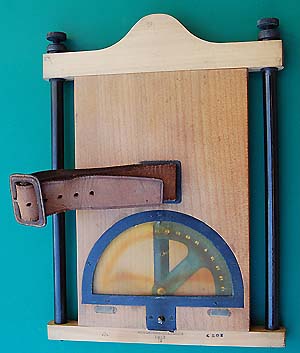
Houghton’s Ltd, London cavalry sketching case (sketching board) no.4502 dated 1913 and marked with the broad arrow. It would have been worn on an army officer’s left forearm so that he could draw on it whilst on horseback. The rollers either side were for holding a roll of paper and there is a slot down each to secure it. On the upper surface there are a magnetic compass, an inch scale and a scale of 2 inches = 1 mile. The instrument on the underside is a clinometer. Usually two stout rubber bands would be placed running from top to bottom on each side to hold a ruler or protractor over the paper.
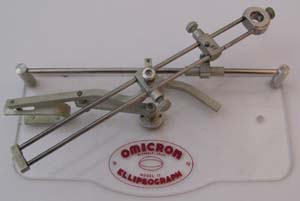
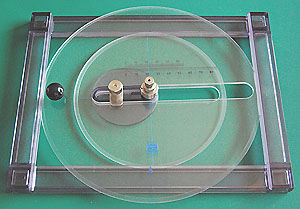
An Omicron Ellipsograph made of acrylic, aluminium and steel. It is actually a modified form of semi-elliptic trammel with a lever system taking the place of the short slide. It has to be turned through 180 degrees once one half of the ellipse has been drawn but can draw a very wide range of sizes of ellipse. Made in the USA, probably 1950s or 1960s. Complete with card box and leaflets.
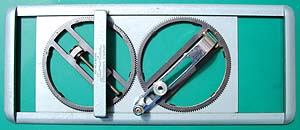
Fowler Engineering, Whittier, California, USA ellipsograph. US patent 2,612,691 issued Oct 7, 1952, Rotating the handle hinged to the right hand gear wheel rotates the left hand one in the opposite direction. An adjustable cross-head, mounted on the left hand wheel, runs in a groove in the underside of the bridge and thus imparts the longitudinal motion on the plate in which the two wheels are mounted. It is complete with card box and a table of settings for isometric ellipses. It is missing the holder for pen/pencil lead/ stylus that screws into the movable mount on the hinged arm.
Haff Ellipsograph Nr. 97, made in Germany. Purchased new in 2009. This is a true ellipsograph and works on the same principle as that devised by John Farey in 1810. It is shown with the pencil lead holder in place, but can also be fitted with a technical pen, such as the Rotring Variant.
A French camera lucida (Chambre Claire Universelle) retailed by Lechertier Barbe of St. Jermyn Street, London SW1. It is probably from the first quarter of the twentieth century but must be post 1912 as the address given in the instructions is SW1. This one has a set of lenses to enable the image to be viewed at different magnifications.
A simple camera lucida, probably of French manufacture. By using a camera lucida, looking through its special prism, a draughtsman or artist could see the actual item superimposed on the drawing and thus had only to trace the outline of the image.
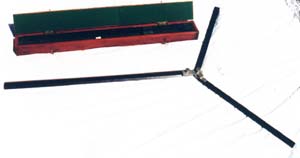
An ebony and electrum centrolinead and fitted case made by Norton & Gregory. This instrument was used for perspective drawing where the vanishing points lay off the drawing. The two short arms rested against special pins inserted into the drawing board & by rotating the instruments about the pins the longer, ruling arm could be used to draw the 'horizontal' lines in perspective. I have correspondence relating to the sale of the instrument, second-hand, in 1919 so it must be older than that.
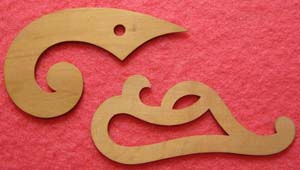
Two from a set of four, large, pear wood French curves.
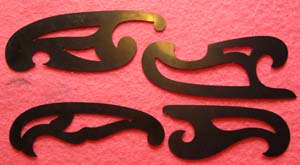
Part of a set of six vulcanite French curves by AJS Ltd, made for the British services, W10/VC0820 (W10/6675994452133). The set has a mahogany, slide top, case.
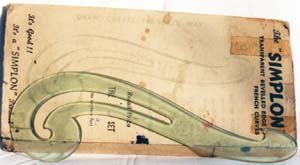
A boxed set of four "Simplon" French curves made of a green tinted, transparent plastic. They were "made in England". Simplon was the trade name of Dargue Bros. The set contains numbers 10, 13, 14 and 15 curves. It retailed for 9/- (no purchase tax). Mid twentieth century.
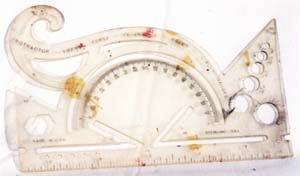
A Sterling 544 "protractor - French curves - triangles - ruler - circle gauges" made in the USA by Sterling Plastics. It is transparent plastic and mid-twentieth century.
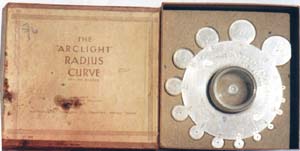
An "Arclight" radius curve Ref. No. 2143/001, registered design 842296, "distributed through the drawing office trade". The original price of 5/6 is still on the box. It is made of a transparent plastic, probably polystyrene, and probably dates from the 1950s. They continued to be available at least into the 1970s.
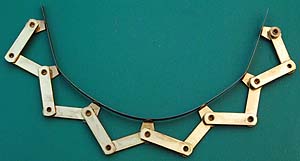
Brooks pattern B twelve inch flexible curve. Stamped 2143/092, which is also printed on the card box. Steel strip and brass linkage. It retains the shape it is bent to. There were a number of different designs of flexible curve by Brooks. A pattern A can be seen further down the page. It was made in a range of lengths from 9 to 18 inches. This is a 12” example.
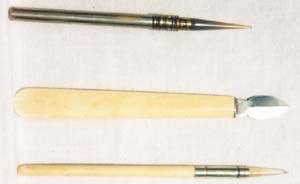
A bone handled eraser (centre) and two agate pointed tracers. The upper one has a metal handle into which the tracing point can be retracted.
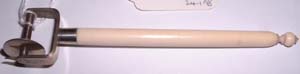
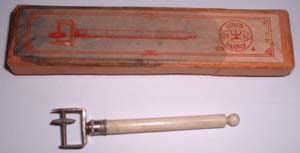
A British made opisometer, somewhat larger than the Unis one. In common with ivory & bone handled pens the country of origin can often be determined by the handle finial and ferrule characteristics.
An opisometer marked Unis of France. The opisometer was used to measure the length of irregularly shaped lines, or distances on a map. In use the wheel was set to the end of the screw and then the instrument was wheeled along the line to be measured. Once this had been done it was wheeled backwards alongside a scale until the wheel again came to the end of the screw, at which point the length or distance was read off the scale. Maker Société des Lunetiers.
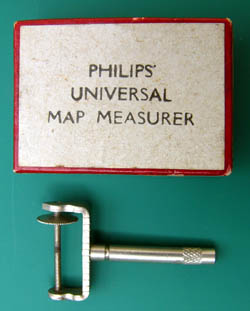
Philips’ Curvimeter or Universal Map Measurer. An opisometer by another name, it is made of nickel-silver and is complete with card box and instruction leaflet. It was priced at 3/- when new, mid 20th century.
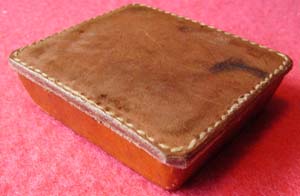
One of set of four, leather cased, drawing or map weights, originally the property of a cartographer. I only have one of the set.
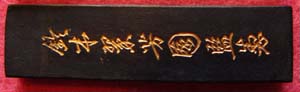
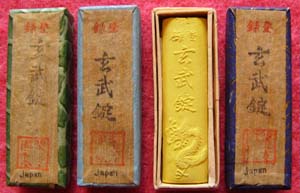
Stick of “Indian” ink, made in Japan. From a cartographer.
Draughtsman’s water colour sticks, made in Japan. From a cartographer.
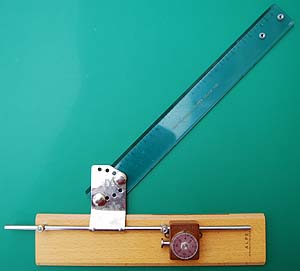
Alpe “Super Velox 300” section liner. The 30 cm ruler can be set to angles of 0, 15, 30 and 45 degrees and the line spacing can be adjusted between 0.5 and 4 mm. The arm and ruler are advanced by pressing the button on the left hand side of the mechanism cover. Made of wood, metal and plastic, probably in the 1960s. Friction mechanism. Italian. Complete with card box and instruction leaflet (in Italian).
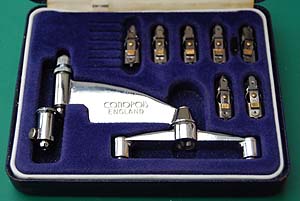
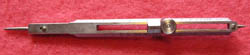
Conopois Instruments Ltd, Cartograph. The selected Graphos nib is fitted to the swivelling part at the left hand end and the lower right hand part is rotated 90 degrees to provide the support. There are rollers in its two feet. It was intended for joining up contour plots on Ordnance surveys. Because the nib is offset and the nib holder is free to rotate it drew a smooth curve or line between the plotted contour points.
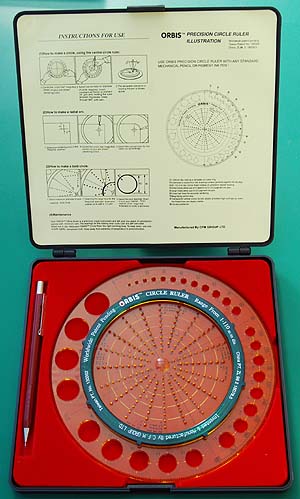
Orbis™ Circle Ruler. Around the edge is a template for circles from 1 to 20 mm. The centre section rotates for drawing circles from 20 to 110 mm. Either the 0.5 mm lead pencil included or a technical pen with nib size up to 0.5 mm could be used with it. Invented and manufactured by C.F.M. Group Ltd.
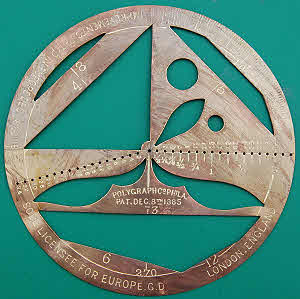
Polygraph combined drawing template and protractor made of brass. Patented by the Polygraph Co of Philadelphia on December 8th 1885 and improved and patented in Europe in December 1886. Sole licensee for Europe G D London England


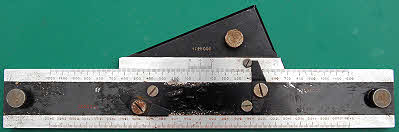
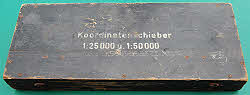
Koordinaten Schieber for scales of 1:25,000 and 1:50,000. A similar instrument can be seen in the 1939 Gebrűder Wichmann catalogue. It was used for accurately plotting coordinates on a map. It is missing the 1:50,000 triangle that is used in conjunction with the lower scale.
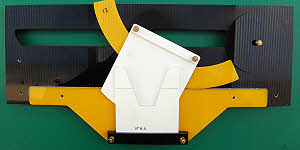
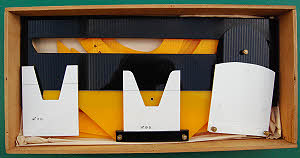
Fearns Odontograph, a device for plotting the profile of involute gear teeth. The arcs supplied enable teeth profiles to be plotted for wheels with seven to one hundred teeth. It is complete with its instructions.
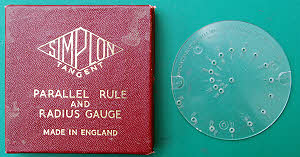
Simplon Parallel Rule and Radius Gauge, made by Dargue Bros. This 3” diameter plastic template could be used, by inserting a pencil point in the appropriate hole and sliding it along an edge, to draw another line parallel to that edge (straight or curved). With a drawing pin pushed through the centre hole, it could be used to draw circles. It is complete with its instruction leaflet. Mid-20th century.
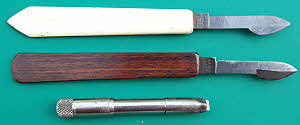
Two erasing knives by F Morgan of Sheffield and a fibreglass eraser similar to one described in the 1916 A G Thornton catalogue, from the Stanley magazine case.
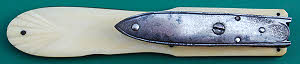

A quill cutter made by Bright & Sons. The quill is inserted from the end and then the lever is pressed down to cut the ‘nib’. There are also two thin knife blades in the ivory clad handle which were used for trimming the quill prior to cutting the ‘nib’.
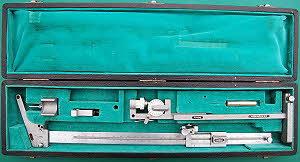
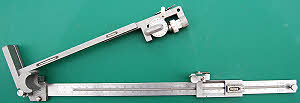
A Ott, Kempten, Bayern, Germany polar coordinatograph serial number 67094. Although it looks superficially like a planimeter it is not used to measure areas but is used to plot points in polar coordinates (i.e. by angle and radius). It has two linear scales, 1:500 and 1:1,000 and the angle scale is in grads (400 grads = 360 degrees). The linear scale has a vernier and the angle is measured on the carriage, the disc being divided every 20 grads, the wheel is divided to 0.2 grad, and the vernier has 10 divisions, thus enabling (by interpolation between two vernier divisions) it to be read to 0.01 grads. This instrument would have been used to plot the results of a tacheometric survey - a tacheometer is a type of theodolite that measures both angle and distance to a feature or another station.
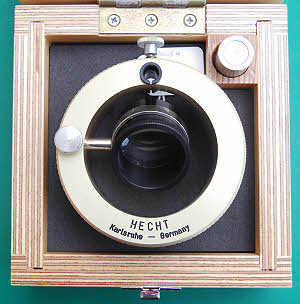
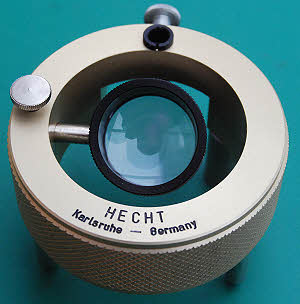
Hecht gravier loupe (engraving lens). In use the pen, pencil or stylus is placed and clamped through the tube at the top of the picture and the lens is focused on the tip. The two feet at the bottom of the picture terminate in steel balls so it is easy to slide around when drawing or engraving. This tool is used by cartographers for accurately drawing contour lines.
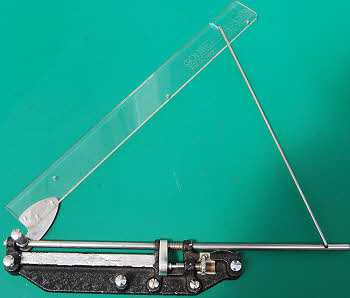
Golmet Auto-Liner section liner made in England, patent pending. The cast metal base has three screw down pins for holding it in place. It is advanced by a friction mechanism and there is a wide range of adjustment for the line spacing. However the long steady rod limits the angles to between about 45 and 90 degrees. The bright parts are mostly steel and the rule appears to be acrylic. Probably made in the 1950s.
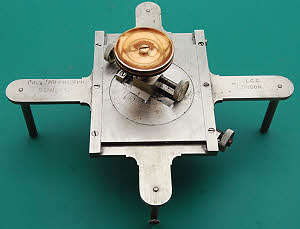
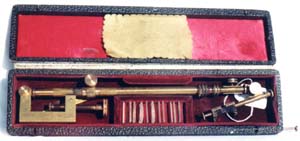
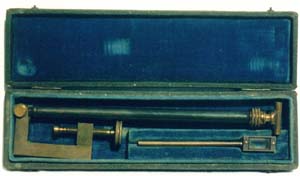
A Finney Elliptograph (ellipsograph) made by W F Stanley. It is probably early 20th century but could be earlier. It was originally the property of the London County Council Polytechnic Architecture School as it is marked ‘Poly. Arch. Sch. L C C’. The major and minor axes can be set using the lower and upper thumb wheels respectively. Each has an index and scale for accurate setting. To use it the large brass wheel is depressed to bring the pencil lead in contact with the paper and then rotated. It has a fitted mahogany case.
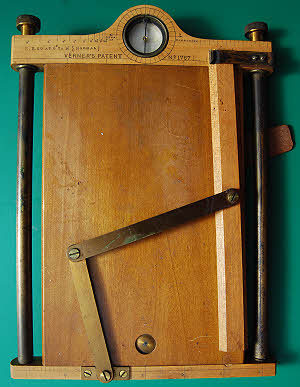
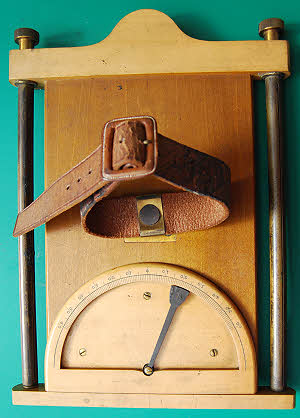
Verner’s patent sketching board no.1767. Captain William Willoughby Cole Verner (later Colonel) patented his sketching board in 1887 and 1891, patent nos: GB1887/4198 and GB1891/22129. The latter patent covered the rule attached by the brass arms and the spring washers to hold the rollers against slipping. Verner patented a number of other instruments as well including a prismatic compass, and also wrote a book on field sketching and reconnaissance. Another version of the sketching board is shown at the top of this page.
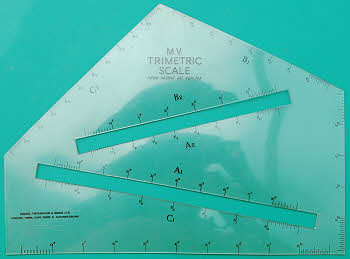
MV Trimetric Scale for producing pictorial (3D) drawings in Trimetric projection, made by Cooke, Troughton & Simms Ltd. Provisional patent no 4871/43. It has a card case and instruction booklet.
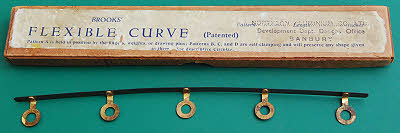
Brooks pattern A flexible curve, 8” size. These were made in a range of sizes from 8 to 24 inches. Brooks patented four types of flexible curve, patterns A to D. The first three used a metal band, the fourth lance-wood splines. A pattern B is illustrated earlier in this page.
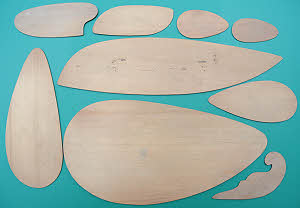
Nine pear wood ship’s curves, the largest is 13 inches long. Probably early 20th century.
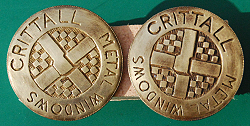
A pair of brass headed drawing pins promoting Crittall Metal Windows. The pins are
almost one inch in diameter. Crittall metal windows were popular between the first
and second world wars. My house was built in 1931 and still has one fine example
- a bow window with French doors that lead into the conservatory.
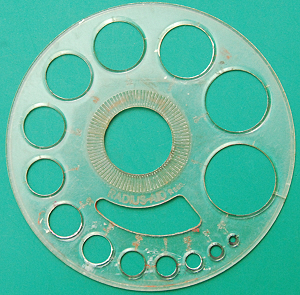
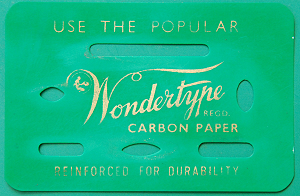
Two useful gadgets from my working days. The radius aid made drawing circles from
1/32 to 1/2 in diameter quick & easy. The erasing shield helped me rub out unwanted
lines and marks safely.
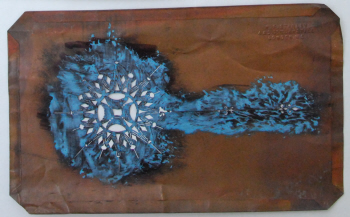
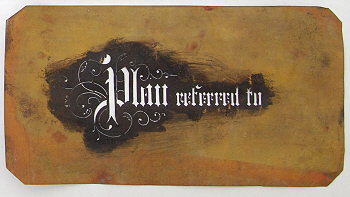
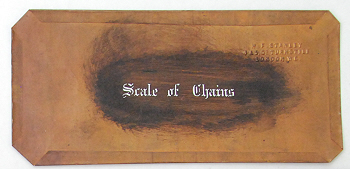
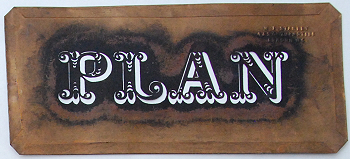
Four examples from a collection of 63 copper and brass stencil plates used by a surveyor.
17 are by W F Stanley including three of those above, the others being unsigned.
They include three sets of numerals, five alphabets (all capitals in a variety of
styles and sizes), and a large number of actual words or phrases. The styles include
church, old English, Roman, block and various fancy ones. More stencils can be seen
in my Harling and Stanley pages.
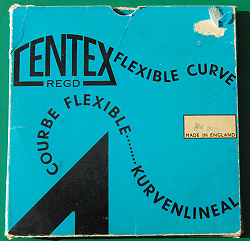
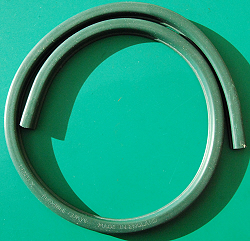
Centex flexible curve and card box. This is a 24 inch long example. They were made
in a range of lengths. Centex was a trade mark used by Harling.It dates from around
the 1960s and has survived intact. The lead core inside was prone to breakage, which
resulted in it becoming impossible to create a smooth curve.