










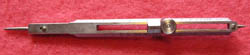

In the days before exposure meters became the norm a whole range of calculators were available to enable the correct exposure to be determined in both day light and artificial light. Some were film or camera make specific, such as those by Kodak, whilst others were generally applicable such as the range made by Johnson of Hendon in the UK.
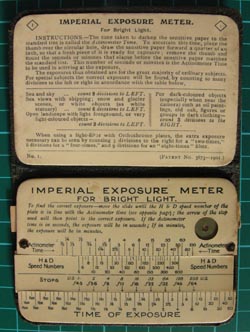
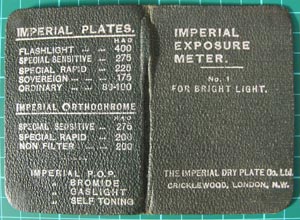
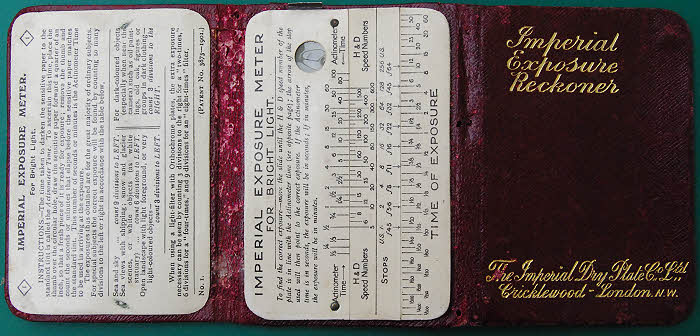
The Imperial Exposure Meter No 1 For Bright Light made by the Imperial Dry Plate Co Ltd, Cricklewood, London NW. The “meter” itself was a strip of sensitised paper which darkened when exposed. The time it took to darken to the right shade was noted. The slide was then moved so that the H&D speed number lined up with the Actinometer time. The exposure time could then be read off against the selected f number. Patent No 3873 - 1901.
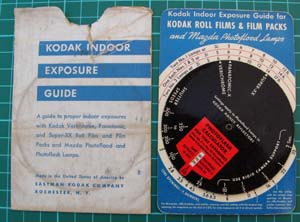
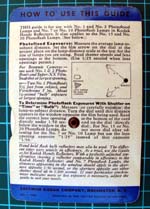
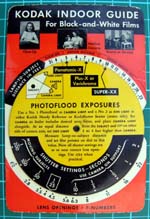
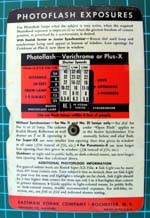
Kodak Indoor Exposure Guide for Kodak roll films and film packs and Mazda photoflood lamps. No 1, 1939.
Plastic coated card. Eastman Kodak Co, Rochester, New York. Enables aperture & exposure time to be determined for various lamp and distance combinations. Also a photoflash calculator for time exposures.
Kodak Indoor Guide for black and white films. Kodaguide 1218 8-41-CH-BEX. Eastman Kodak Co, Rochester, New York. The front side is again used for calculating photoflood exposures but there is now an aperture on the reverse for determining aperture with synchronised or unsynchronised flash for various flash bulbs. Both this and the previous guide were obtained from the USA.
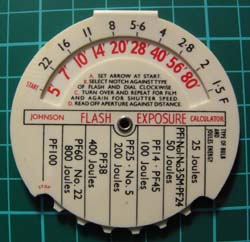
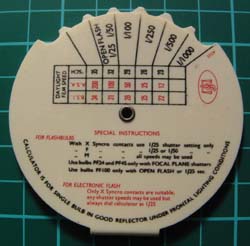
Johnson Flash Exposure Calculator. Celluloid. It was used rather like a telephone dial. After setting the arrow against ‘start’, first the type of flash was dialled in, then the calculator was turned over and the film speed dialled, followed by the shutter speed. The aperture could then be read off against the appropriate distance. There were special instructions for electronic flash.
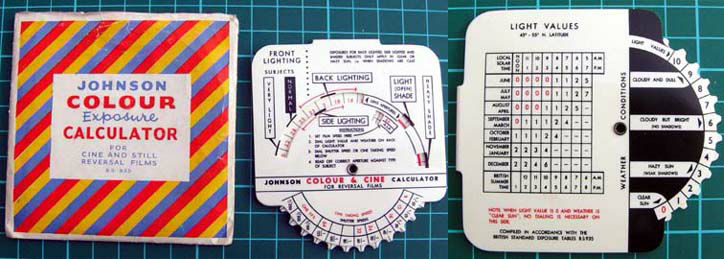
Johnson Colour Exposure Calculator for Cine and Still Reversal Films BS935. It was used in a similar way to the flash calculator above. First the disc was rotated until the film speed showed in the window, then the calculator was turned over and the light value was dialled in after selecting it from the table. Then, on the front again, the shutter speed (still) or taking speed (cine) was dialled and the aperture read against the type of lighting. It has a paper envelope and instruction sheet. Introduced in 1957. Plastic, probably celluloid.
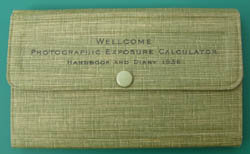
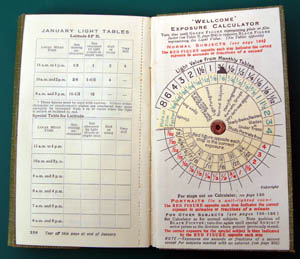
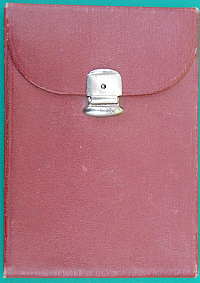
“Wellcome” Photographic Exposure Calculator, Handbook and Diary 1936. Mint condition and unused, The data for use with the disc calculator in the back cover is obtained from the tables on the pages of the handbook.
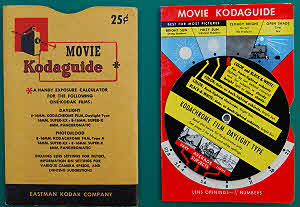
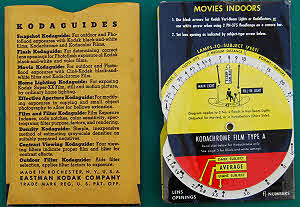
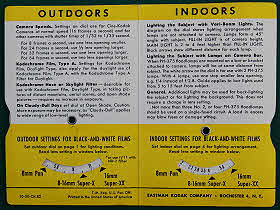
Eastman Kodak Company ‘Movie Kodaguide’ for outdoor and indoor cine photography using daylight and type A Kodachrome films. Obtained from the USA. Original price 25 cents; probably from the 1950s. 10-50-CH.R2.
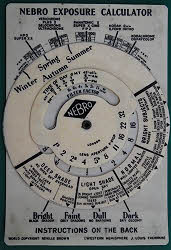

NEBRO exposure calculator, copyright |Neville Brown. It has two rotating discs and the instructions are printed on the reverse. It is made of celluloid
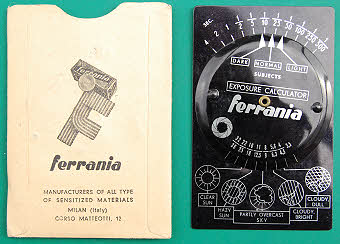
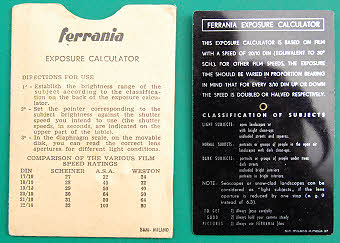
Ferrania exposure calculator made in Milan. It is metal with a single rotating disc and has a cardboard sleeve. The instructions are on the sleeve
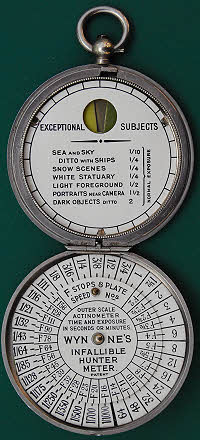
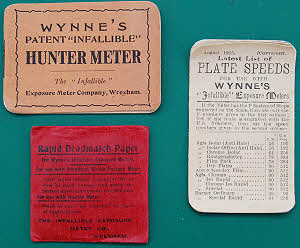
Wynne’s Patent “Infallible” Hunter Meter. This hunter cased device has an actinometer in the body and an exposure calculator in the cover. The “meter” itself was a circle of sensitised paper, a segment of which was exposed each time the meter was used, which darkened when exposed. The time it took to darken to the right shade was noted. This was then input to the calculator. The meter is complete with its instruction booklet, a folded card of plate film speeds dated 1925, and an unopened pack of replacement actinometer sheets.The case is opened by depressing the little button inside the ring.


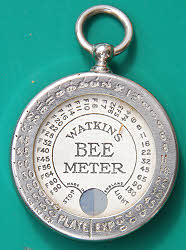
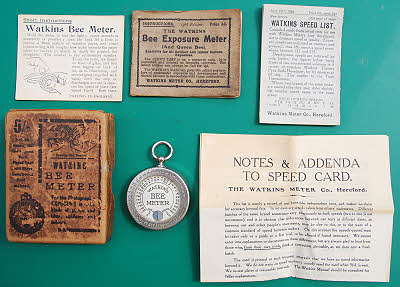
The Watkins Bee Meter was another actinometer and it functioned in the same manner as Wynne’s meter above. It was made by the Watkins Meter Co of Hereford. This one has its original box, an instruction card and booklet, a speed list dated 1923, and a leaflet ‘Notes & Addenda to Speed Card’. It cost 5 shillings new. Spare actinometer sheets are stored in the back of the meter case.
Alfred Watkins (a master miller from Hereford) held several patents for actinometers. His first patent was 1890/1388. One patent, 1893/14364, was for a cylindrical device. Thereafter the pocket watch type went through various refinements to the final version actually produced. These patents were 1894/25000, 1898/26281, 1900/19331, and 1902/27822.
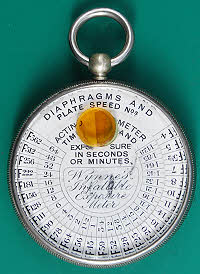
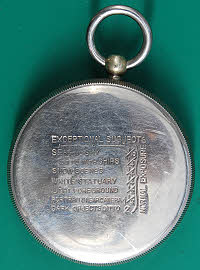
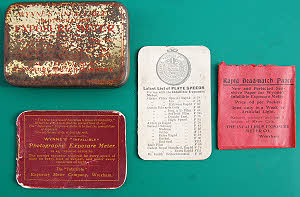
Wynne’s “Infallible” Exposure Meter with the tin, etc it came with. 1908 dated table of plate speeds.
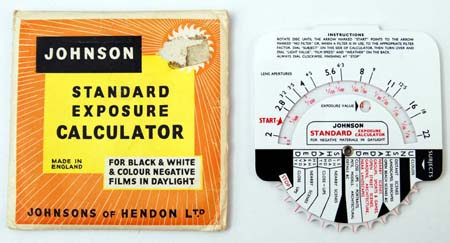
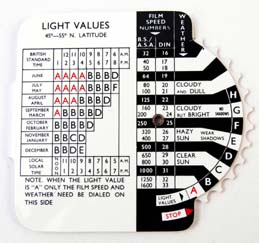
Johnson Standard Exposure Calculator for Black & White & Colour Negative Films in Daylight. Another calculator from the range of Johnsons of Hendon Ltd. It also has its paper envelope and instruction sheet, the latter with a printing date of 1968. Construction is the same as for the Colour one above. In use first the filter factor was set against ‘start’, then the subject group was selected and dialled to ‘stop’. Then the calculator was turned over and the light value, the film speed and weather conditions successively dialled. Then on the front of the calculator the shutter speed could be read off against the chosen aperture.
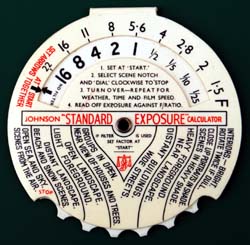
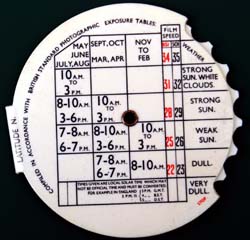
Johnson Standard Exposure Calculator. This was the earlier form of the “Standard” calculator, dating from the early 1950s. Its construction is the same as the Flash calculator. It is made of Ivorine (Celluloid). Its operation was similar to that of the later model but using Time rather than Light Value.


Johnson Artificial Light Exposure Calculator made of Ivorine, same size and constructions as the Flash calculator, made in the 1950s. It is complete with paper envelope and instruction leaflet.
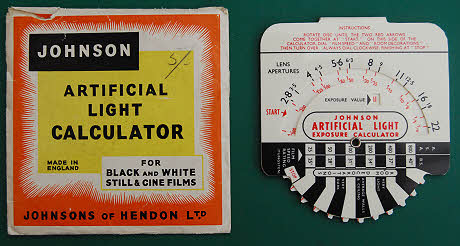
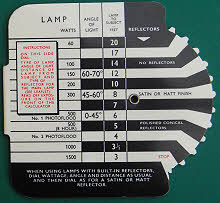
The later type of Johnson Artificial Light Calculator. It too is complete with instructions and envelope.
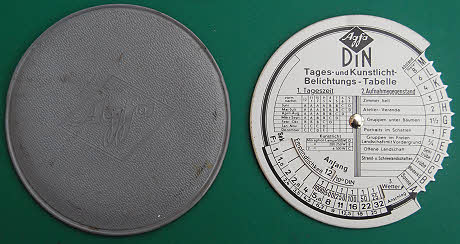
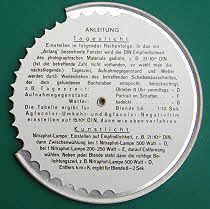
Agfa DIN exposure calculator (German language) and PVC case.
Wynne’s exposure meters were the subject of patent GB1893/10617.
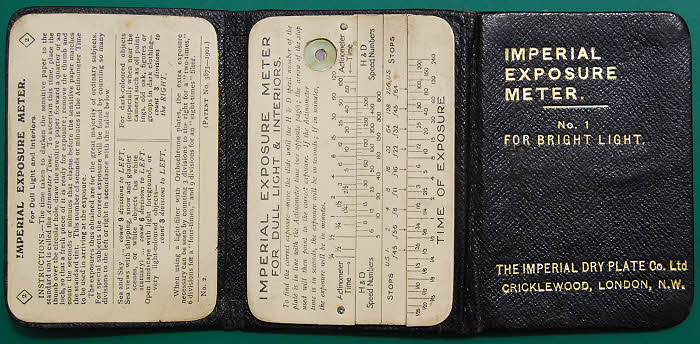
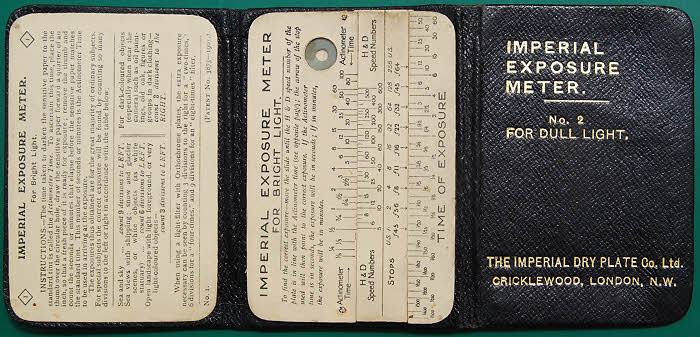
A combined version of the Imperial Exposure Meter (nos. 1 & 2) for both bright and dull light. An individual version of the no.1 is described at the top of the page and the operation of the dull light version is the same, but the times of exposure are longer.
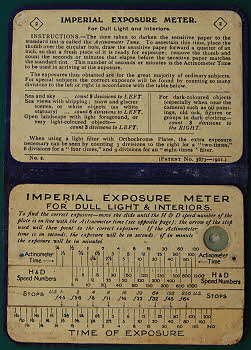
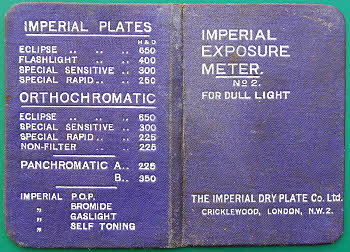
Imperial Exposure Meter No 2 for dull light. This is a later meter than the previous two. The address is now NW2 (not NW), The range of emulsions is now faster and includes panchromatic, and the slide rule H&D speed scale maximum has been increased from 600 to 1200. Probably Ca.1930.
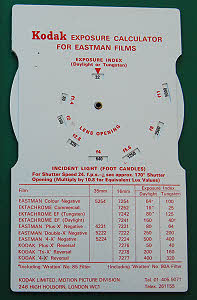
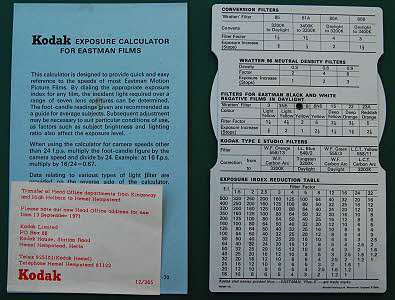
Kodak Exposure Calculator for Eastman Films. This is a simple calculator for movie film and a camera speed of 24 fps. Other camera speeds could be allowed for by a simple factor. Ca.1971. It has a grey PVC sleeve.
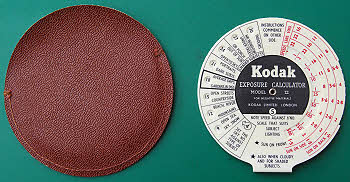
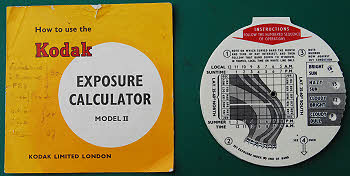
Kodak Exposure Calculator Model II (Kodak Ltd London). A simple celluloid calculator similar in construction to those made by Johnson. It has a single rotating disc inside the folded outer. It has a PVC imitation leather case and an instruction leaflet. In use there are five stages: 1 -on the reverse select the time and month on the graph and note the curved shaded band that falls in; 2- rotate the rotor until the BS film speed appears opposite the end of the selected band; 3- note the number against the appropriate light conditions; 4 - turn the calculator over and set that number against the type of subject; 5 - select the aperture and film speed combination.
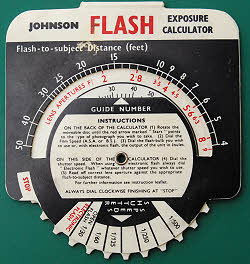
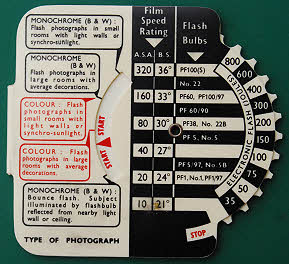
This is the later version of the Johnson Flash Exposure Calculator. Starting on the reverse side, the ‘start’ arrow is set to the type of photo and room. Nest the speed rating for the film is dialled in followed by the type of flashbulb. It is then turned over and the shutter speed (or electronic flash) is dialled. The aperture can then be read off against the distance to the subject. It probably dates from the 1960s.
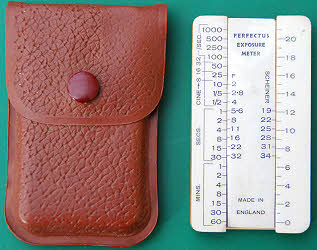
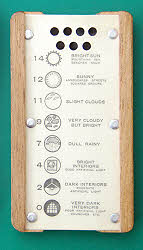
Johnsons of Hendon Perfectus visual exposure meter with vinyl case. It is complete with its instruction sheet. Firstly the slide was moved down to expose the seven holes and, with these shaded from above with the finger a number was then read that depended on the strength of the light. This was added to the number on the reverse corresponding to the
appropriate weather symbol. With the meter now face up the Scheiner number for the film speed was set against the number just computed and then the shutter speed could be read off against the chosen aperture. Under the slide is a comparison table of Scheiner and DIN film speeds.
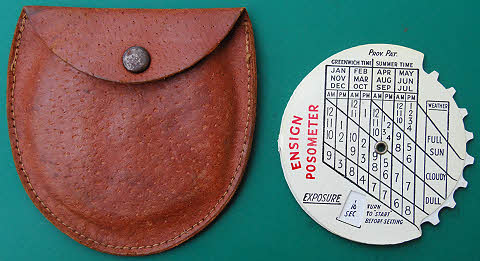
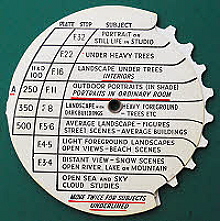
Houghton-Butcher “Ensign Posometer” with leather pouch. It also has its instruction sheet. This dialling type calculator dates from the 1930s. To use it: 1) set exposure to “start” in window, turn over; 2) dial in H&D film speed, then desired aperture and finally subject type, turn over; 3) dial in month and time of day, then weather: 4) read exposure in window. Folded celluloid outer with rotating celluloid disc inside.
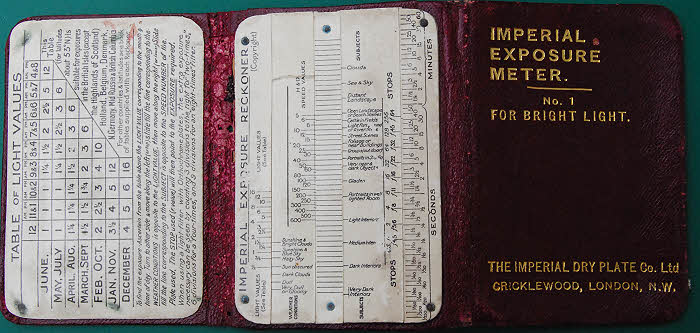
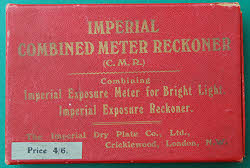
Imperial Combined Meter Reckoner. This combines a bright light meter similar to that at the top of the page and a reckoner (exposure calculator). The latter is in the form of a slide rule with two separate slides, together with a table of light values. To use the reckoner, first look up the light value in the table; set the first slide weather conditions against the light value; move the second slide to set the subject against the H&D speed value; read the shutter speed against the aperture. It is complete with two instruction booklets (date coded for 1922), a speed table extracted from the Amateur Photographer & Photography magazine for September 1923, a packet of spare actinometer papers, and its box.
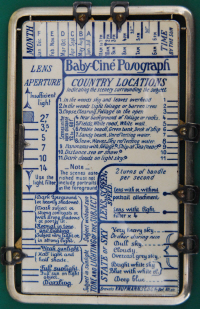
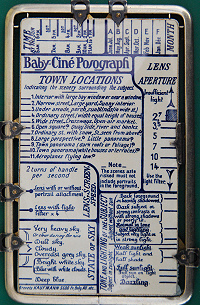
Kaufmann Baby Ciné Posograph mechanical exposure calculator for ciné cameras. One
face is for town locations and the other for country. Moving each of the arrows in
turn to the appropriate points moves the lens aperture indicator to show the required
lens aperture. Patented in France and other countries.
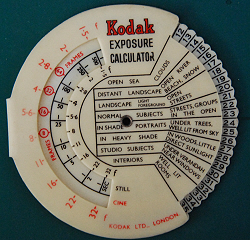
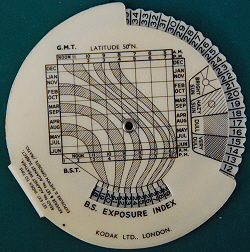
The first version of the Kodak Exposure Calculator in round, folded celluloid form.
The Model II version can be seen earlier on this page. It has a round PVC slip case
similar to the Model II and it works in a similar way.
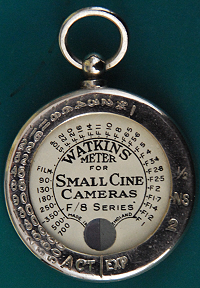
Watkins Meter for Small Ciné Cameras F/8 Series, for use with cameras such as the
Ciné Kodak or the Baby Pathé. It was introduced in 1927.
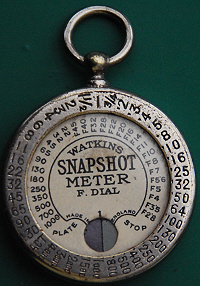
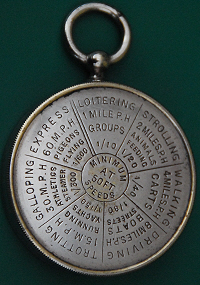
Watkins Snapshot Meter F Dial. To use it the time it takes for the freshly exposed
part of the sensitised paper to darken to the same shade as that shown adjacent to
it is noted. The dial is then rotated until the plate (film) speed is set against
the time (ACT), A suitable combination of exposure (speed) and f number (aperture)
can then be selected noting the minimum speeds on the back of the meter.
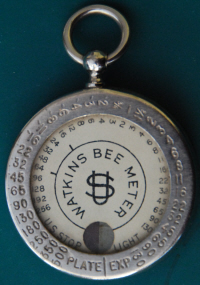
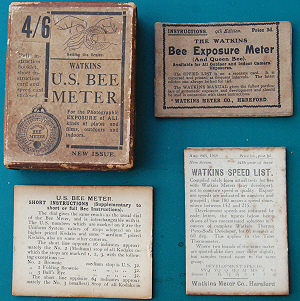
Watkins US Bee Meter. This is essentially the same as the usual Bee meter seen further
up the page except that the F numbers are from the US series used on the more expensive
Kodak cameras. Besides the usual instructions it has a supplement explaining the
US system & settings for various Kodak cameras. The Speed List is dated 1918.
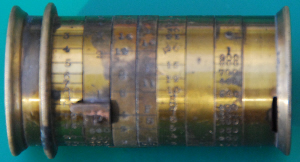
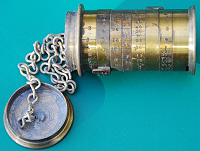
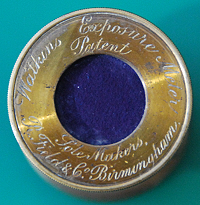
Watkins Exposure Meter made by R Field & Co. Birmingham, and dating from the 1890s.
From left to right the scales are: P = Watkins Plate Speed; S = Subject (type of
subject/lighting, default is 100); D = Aperture (US & European F numbers); A = Actinic
value in seconds (measured);E = Exposure time in seconds. To use it these values
are set in order (S and D being set to suit the type of subject and the chosen aperture
respectively, and the exposure time (shutter speed) can be read on the last ring.
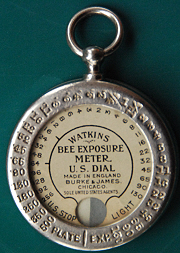
Watkin’s Bee exposure meter with US dial. It is the same as the US dial meter above
except that it has the US agent’s name: Burke & James, Chicago, sole United States
agents.