










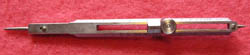

The firm was founded by William Elliott (working 1807-53). In 1850 he formed a partnership with his sons, Frederick & Charles (Elliott & Sons) and the firm became Elliott Bros from 1854. They became successors to Watkins & Hill by 1856. The firm much later became part of GEC after moving progressively into electrical equipment and automation. It is now part of BAe Systems.
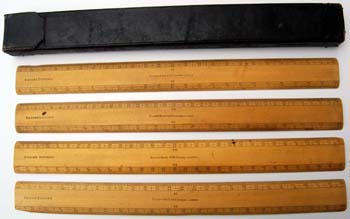
A set of Elliott Bros chain scales in a leather covered case. The single sided twelve inch scales are for 30 & 60, 25 & 50, 20 & 40, and 35 & 45 to the inch.
The address on the scales and the box is 449 Strand, London giving a date between 1864 & 1886.
The address on the scales and the box is 449 Strand, London giving a date between 1864 & 1886.
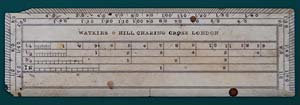
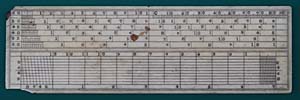
Watkins & Hill, Charing Cross, London ivory rectangular protractor. Watkins and Hill were taken over by Elliott Bros in 1856, both partners having died by 1847 and the firm having been continued by A Day. The protractor probably dates from the 2nd quarter of the nineteenth century. It is the small (4 1/2”) size typically placed in small pocket cases.
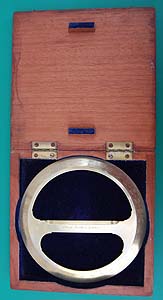
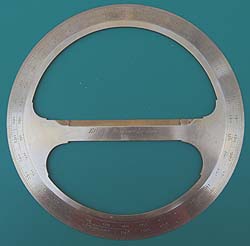
A six inch lacquered brass protractor, signed “Elliott Brothers London”. I t has a fitted mahogany case lined with blue velvet. The original price is still written on the bottom of the box, “22/6” (twenty two shillings and six pence). This dates it to the late Victorian or Edwardian period.

William Elliott, 268 High Holborn, London, ivory scale rule, ‘10’ (to the inch). It dates from 1835-49.
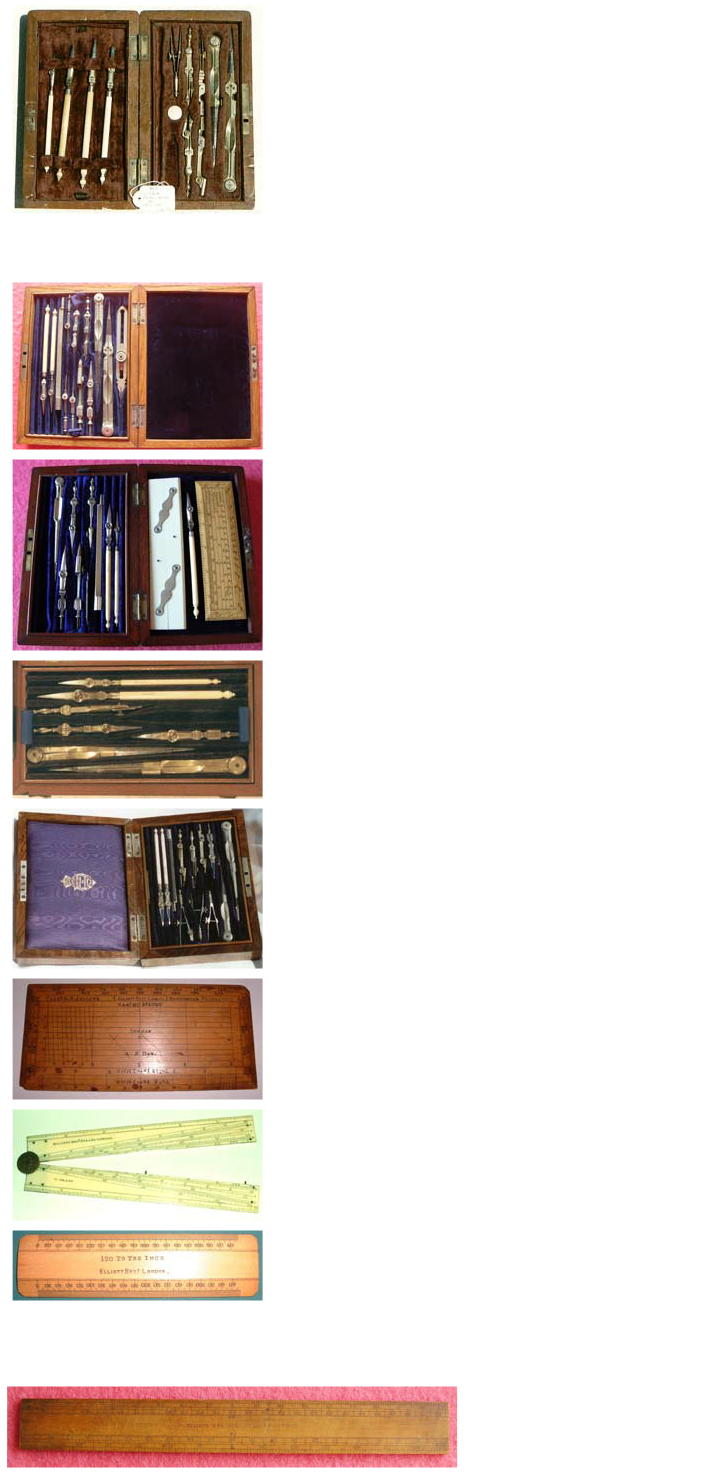
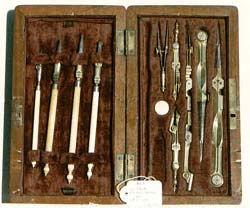
A fine set of drawing instruments by W Elliott of 268 High Holborn, London, housed in a mahogany box with two lift out trays, lined throughout in purple velvet. They date from between 1835 and 1849.
The upper tray contains four ivory handled pens,one of which is a dotted line pen for which spare wheels are housed in a small, circular, ivory box in the lower tray.
The lower tray contains the compass and its inserts; hair dividers; pen and pencil bow compasses and divider spring bows. The extension bars & adjusting key for the compass are missing.
Under the upper tray are recesses for water colours , whilst under the lower tray is a signed ivory rectangular protractor.
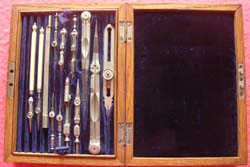
An electrum set by Elliott Bros dating from the mid-Victorian period, housed in an electrum bound, oak case. The pen spring bow and pencil bow compass are replacements (not Elliott).
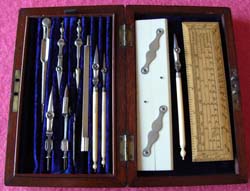
An Elliott Bros, electrum set in a brass bound, mahogany case. The 6" compass is missing.
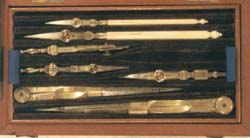
A set of Elliott Bros brass instruments in a mahogany case from the late Victorian period. The dividers and pencil bow are replacements (not Elliott).
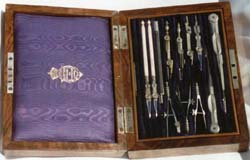
A fine, nickel-silver set of small size instruments in a walnut veneered box. The base of the box contains an ivory rectangular protractor and an ebony parallel rule, both signed Elliott Bros, London. The address given on the silk inside the lid is 101 St. Martins Lane.
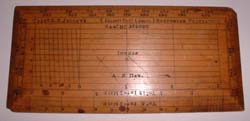
A Capt. R F Jelley's sketching protractor (Reg no 374020) with diagonal & map scales on the face and tables of horizontal equivalent on the reverse, made by Elliott Bros, the design was registered in 1901. Intended for use by army officers.
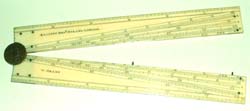
A fine English, ivory sector by Elliott Bros, Strand, London dating from between 1854 and 1880. This is very typical of nineteenth century sectors, having scales for inches, decimal feet, lines of sines, tangents, equal parts, chords, numbers (log scales for multiplication), polygons, secants. It is a six inch size example.
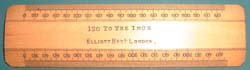
An Elliott Bros boxwood scale rule, "120 to the inch". The rule is approximately four inches long and was intended for use with engine indicator diagrams. The scale is 120 pounds/sq.in to the inch. A spring of the same rating would have been fitted to the indicator cylinder, to resist the pressure of the steam or combustion gases acting on the piston., which was connected to the recording pen.


Fifteen inch, ebony & brass, parallel rule signed Watkins & Hill, Charing Cross, London. Dates between 1822 & 1856.
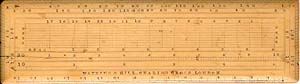
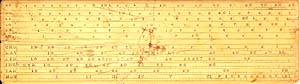
Watkins & Hill, Charing Cross, London 6” ivory rectangular protractor. This protractor has the much less common set of scales for dialling or navigational use. The diagonal scales have been placed on the front and the bottom half of the reverse has the following scales: CHO, LAT, SIN, INCL MER, TAN, HOU, RUM, SEC, P. It dates between 1822 and 1856 but I feel that it is likely to be from the earlier part of this period because of the scales it has on it. The only other protractor I have with this set of scales is in the Jacob & Halse set of 1809/10.
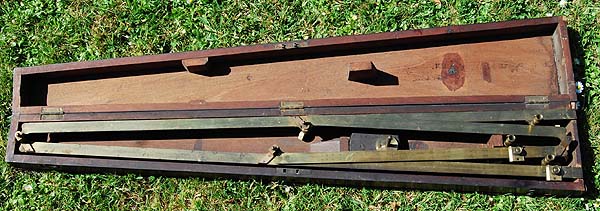
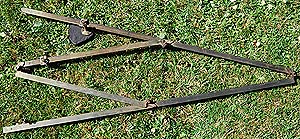
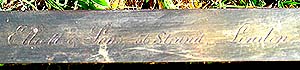
Elliott & Sons 56 Strand London pantograph. Brass with bronze fittings and ivory castors, 36” size, made between 1850 and 1853. Elliott & Sons 1851 price list (bound in the 1851 edition of J F Heather’s Treatise on Mathematical Instruments} lists pentagraphs (old spelling) from 5½ to 10 guineas. Complete with mahogany box and lead weighted fulcrum but missing tracing point and pencil holder. The picture below shows the replicas I have made together with a replacement box fitting, which was also missing.
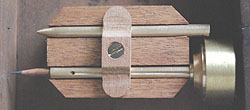
Ron Bristow and John Bateman helped me with photos and details, from instruments in their collections, of the missing parts.
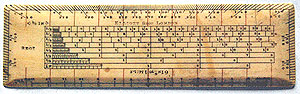
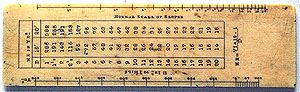
Elliott Brothers six inch ivory rectangular protractor. It has 0 - 180 and 180 -0 degree scales, 1/8 to inch plain scales and a yards 6” to 1 mile scale on the front, and a yards 8” to one mile scale, normal scale of slopes, and table of horizontal equivalents on the reverse. A military sketching protractor. Ca. 1900.
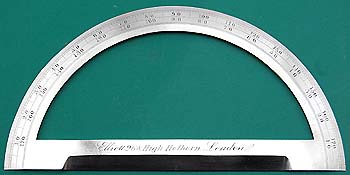
6.4” German silver protractor by William Elliott, signed Elliott 268 High Holborn London dating from 1835-49.
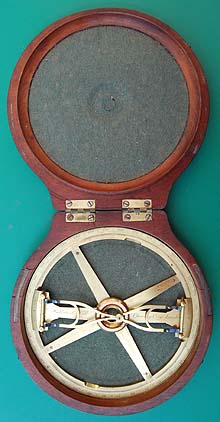
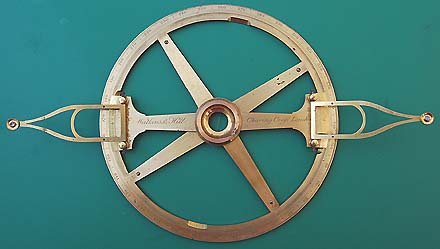
Brass 6¾ inch diameter folding arm protractor signed Watkins & Hill, Charing Cro∫s, London, dating from the second quarter of the nineteenth century.

18” ebony, ivory and brass architect’s rolling parallel rule signed W ELLIOTT 268 HIGH HOLBORN LONDON dating from 1835-49.

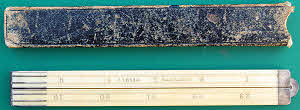


Four fold two foot ivory rule signed W ELLIOTT 268 HIGH HOLBORN LONDON dating from 1835-49. The inner & outer broad faces have inches by twelfths & sixteenths on them respectively. The outer edge has decimal feet. The inner edges have 1/2, 1/3, ¼ & 1/6 scales on them. The central hinge is arched and the other joints are side plated. It has a leather case.
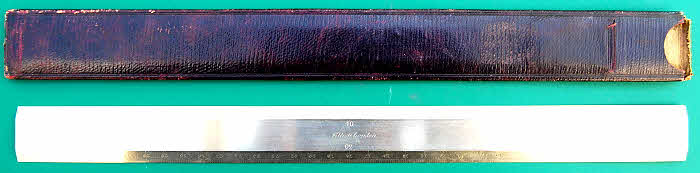
Twelve inch electrum chain scale for 30 and 40 links to the inch, signed Elliott London in script with a leather case that has lost its flap.
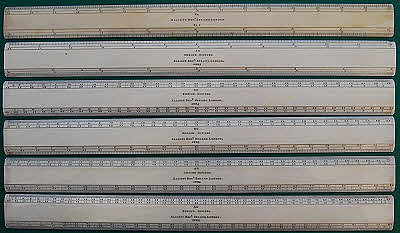
A set of six twelve inch ivory scales signed Elliott Bros. Strand London. The upper scale is a ¾ and 1½ size architects scale. The other scales are chain scales for 10, 30, 50, 60 & 80 links (to the inch) with equivalent feet on the lower edge. (1854-86). All have the original owner’s name (Norris Bretherton) on the reverse.
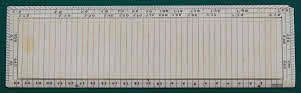
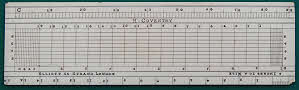
An ivory protractor of the sort used by army officers signed Elliott 56 Strand London, dating from the 1850s. It also has the owner’s name (Coventry) on it.


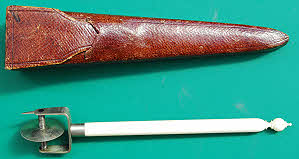
An opisometer of ivory and electrum, signed W Elliott 56 Strand. The leather case is typical of Elliott products. Date ca. 1850
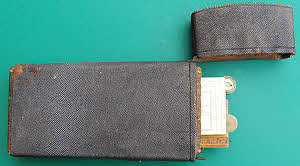
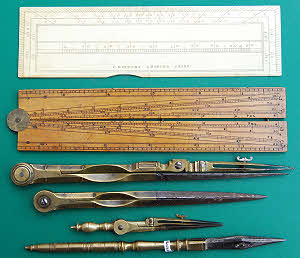
This set includes a Jeremiah Watkins (working at Charing Cross from 1798 to 1810) signed ivory protractor that is too narrow for the slot in the case. The pen is not original. The compass is missing its divider and pencil points and is also possibly not original. Probably only the sector, dividers, and bow compass are..
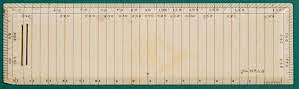
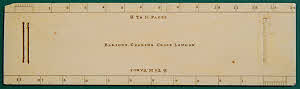
Another ivory protractor, this one is signed Elliott Charing Cross London and is presumably therefore ca.1857. The two slots were for a ribbon so that the officer could wear it round his neck. The owners name has been scratched out.
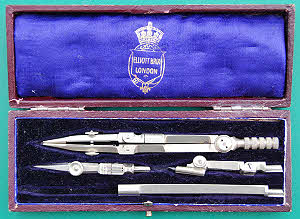
Elliott, London bow compass set in electrum dating from ca. 1890s. The case is covered in imitation Morocco.
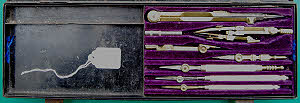
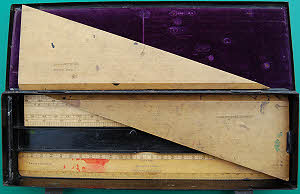
Elliott Bros Woolwich case of brass instruments. It is missing a protractor, set squares and some scales but the metal instruments are all there.
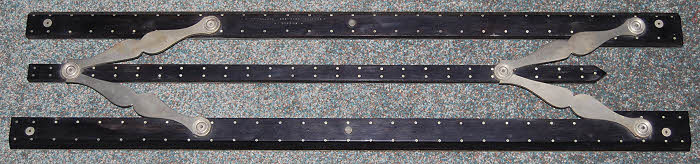
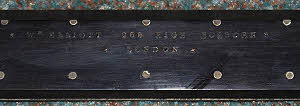
A three arm parallel rule signed Wm Elliott 268 High Holborn * London. It is 30” long and made of ebony, 3/8” thick, backed by a 1/8” thick electrum plate riveted to it. The links are also electrum about 3/16” thick. Very heavy, it has a brass bound, blue velvet lined, mahogany case. 1835-49. It is probably missing four lifting knobs that would have screwed into the electrum bushes at each end.
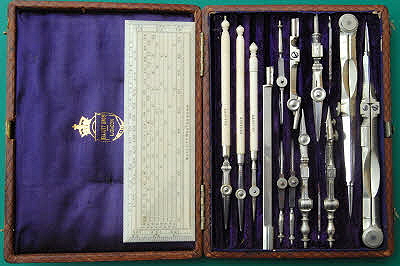
A fine Morocco cased set of small size drawing instruments by Elliott Bros, dating from the late 19th century. The instruments are electrum with ivory handles and the ivory rectangular protractor is the 5” x 1.6” size.
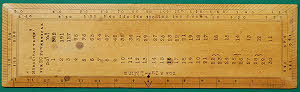
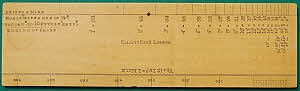
A very basic boxwood military sketching protractor signed Elliott Bros London. The front face has degree scales, a 6”=1 mile scale and a table of horizontal equivalents for a vertical interval of 20 ft. The reverse has a 12”=1 mile scale and another table of horizontal equivalents for a vertical interval of 10 ft. Probably about 1900 it belonged to Ivor Phillips of the 2nd battalion the Manchester Regiment according to the name in ink that has been cleaned off.
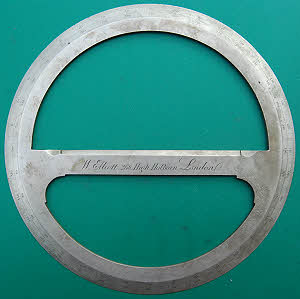
William Elliott, 268 High Holborn, nine inch circular protractor in electrum dating from (1835-49)
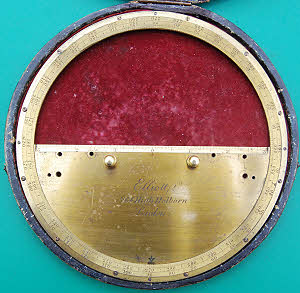
Another William Elliott circular prottractor from the same period. It is lacquered brass and 7 inches diameter, and has a circular case covered in very thin black leather and lined with velvet. Unusually it has a rotating centre section. There are four steel pins that hold the outer circle in place whilst the knobs are used to rotate the inner section, the straight edge of which acts as a ruler.
I do not know what the four holes each side were for and would like to find out.
I do not know what the four holes each side were for and would like to find out.
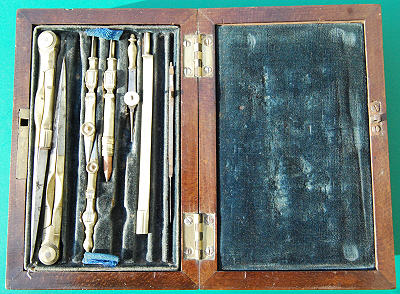
William Elliott, Great Newport Street set dating from 1817-
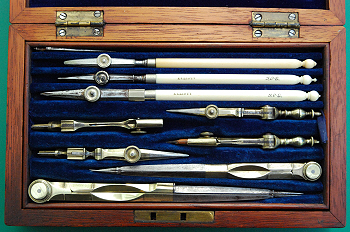
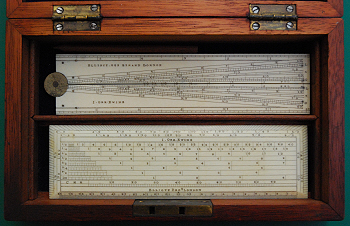
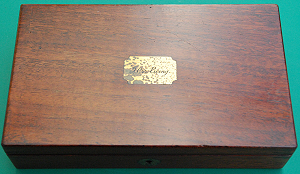
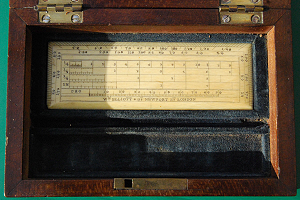
Elliott Bros 449 Strand London set dating from 1864-
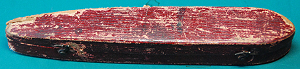
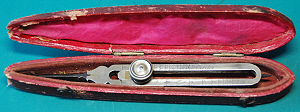


Watkins & Hill proportional divider, an early example of the use of nickel-
| Early Sets |
| Traditional Sets |
| Later Sets |
| Major Makers |
| Instruments |
| Miscellanea |
| W F Stanley |
| A G Thornton |
| W H Harling |
| Elliott Bros |
| J Halden |
| Riefler |
| E O Richter |
| Kern, Aarau |
| Keuffel & Esser |
| Compasses |
| Pocket compasses |
| Beam compasses |
| Dividers |
| Proportional dividers |
| Pens |
| Pencils |
| Rules |
| Protractors |
| Squares |
| Parallels |
| Pantographs |
| Sectors |
| Planimeters |
| Map Measurers |
| Miscellaneous |
| Materials Used |
| Who made them |
| Who made these |
| Addiator |
| Addimult |
| Other German |
| USA |
| Miscellaneous |
| Microscopes |
| Barometers |
| Hydrometers & Scales |
| Pedometers |
| Surveying Instruments |
| Other instruments |
| Workshop Measuring Tools |
| Catalogues & Brochures |
| Levels & Theodolites |
| Compasses & Clinometers |
| Miscellaneous surveying |
| Micrometers & Verniers |
| Engineering rules and gauges |
| Wood rules & calipers |
| Dial gauges & miscellaneous |