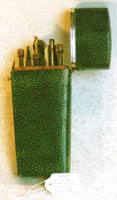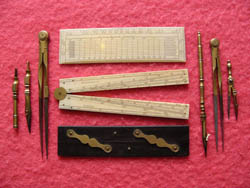

A fine set of English drawing instruments housed in a silver mounted, shagreen, flip-top case. The metal instruments are brass with steel points and are comprised of: dividers; compass with divider, ink and crayon inserts; ruling pen with protracting pin in handle; ink bow compass.
The ivory rectangular protractor and sector are both signed Jacob & Halse. There is also an ebony and brass parallel rule.
The instruments date from c1809/1810.
The instruments from the Jacob & Halse set. There should also be a knife key and a pencil holder, which are the only items missing.
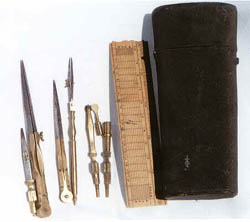
A typical set of late eighteenth century drawing instruments housed in a fish skin, flip-top case.
The metal instruments comprise: a compass with divider, ink, dotting wheel pen and crayon points; dividers; ruling pen and pencil holder/eraser. They are made of brass with steel points and are of considerably cruder manufacture than those in the Jacob & Halse set
There are also a boxwood plotting scale and a brass protractor (not shown). The set is unsigned.
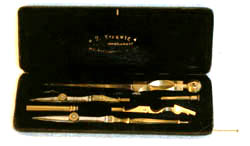
A small but very high quality set by the Dutch maker H. Meeuwig, den Oude Gracht (the Old Canal), Haarlem, contained in a leather covered pocket case with typically continental bolt fastening to the case. It dates from the 2nd half of the nineteenth century.
Each country had its own style. These are heavily made in brass and steel with distinctive scroll ornamentation. There is a separate holder for a pencil lead which can be placed in the pencil insert for the compass.
A Georgian set, circa 1800, in a mahogany box lined with red velvet. The pencil insert for the compass and possibly two bow compasses or a pencil are missing.
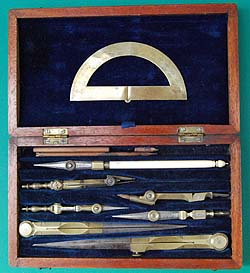
Mid 19th century brass set, probably for student use. The compass and dividers have long joint heads and the fixed leg of the compass has no knee joint. The ruling pen has a block nib and does not open for cleaning. The compass inserts are retained by a screw in the old manner.The pencil bow and protractor are replacements. The mahogany box is lined with blue velvet and the protractor is stored behind a flap inside the lid.
It is very difficult to date these sets and it could have been made at any time between about 1830 and 1880, or possibly even 1900..


By early sets I mean ones that have been made before about 1850. Pocket sets were typically housed in fishskin or shagreen covered cases, sometimes called etuis, like the Jacob & Halse set below. Larger sets might be housed in mahogany boxes like the William Elliott one shown in the Elliott Bros page. Most instruments in this period were made of brass, although silver was used for sets for the rich. Nickel silver was introduced towards the end of the period.
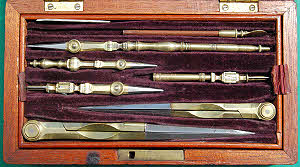
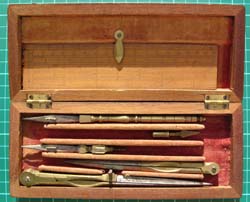
This mahogany boxed set in brass probably dates from ca. 1830. The pen handle unscrews at its mid-point to reveal a pricker. All the pen nibs are hinged. Below the tray are an ebony parallel rule and an ivory rectangular protractor.
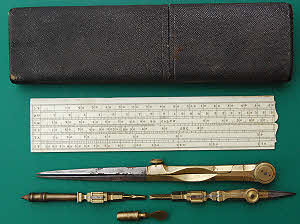
A fish skin case with a pull off top containing an ivory scale, a brass compass with ink, pencil and plain points, and a pencil holder/eraser dating from the early 19th century.
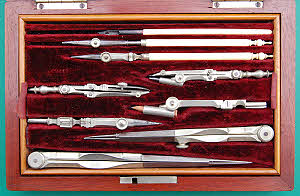
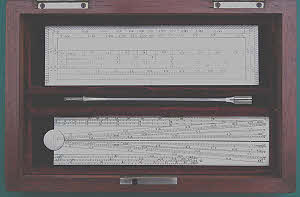
This electrum set probably dates from the 1850s and is complete with its ivory sector and protractor. It is unsigned.
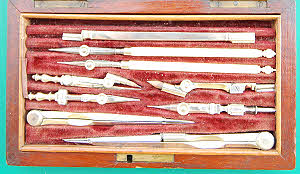
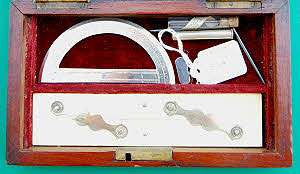
This set of electrum instruments also probably dates from the 1850s. The instruments are the smaller size but the similarities in style and box design suggest these could be by the same maker as the set above. The protractor is also electrum.
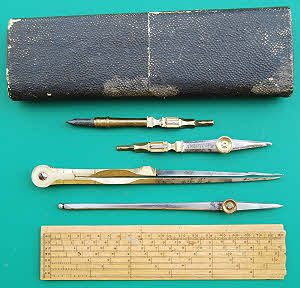
This small brass set dates from the early nineteenth century. The steel pen is quite unusual. The case is covered in imitation fish skin and the instruments are of mediocre quality but the set appears to be complete.
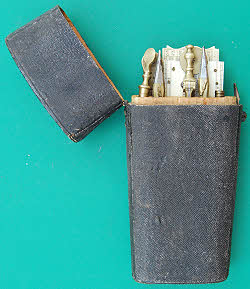
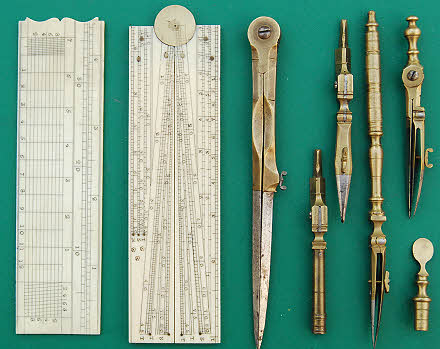
This set in a fish skin case dates from about 1800. The ivory and brass instruments are small size ones (4 1/2 inch rather than the more usual six inch). The instruments are all original and in excellent condition but the set is missing a small brass protractor and dividers.
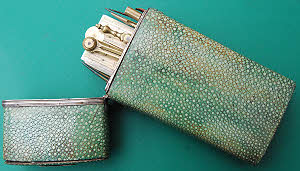
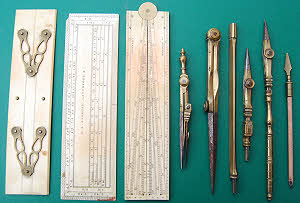
This set by A Abraham of Liverrpool is housed in a green dyed shagreen case that is silver mounted. The instruments are brass and good quality. The ivory rectangular protractor and sector are both signed but the ivory three bar parallel rule is not although it appears to be original. The set is missing the compass with its plain and pencil points but the ink point and extension bar are present. The pencil holder is a replacement of the correct type.
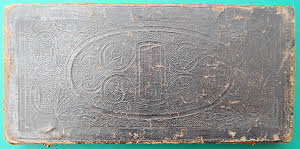
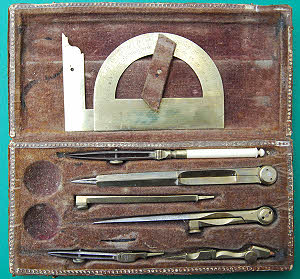
This set is from Southern Germany and dates from ca. 1840. The top of the leather covered case is finely embossed. The velvet lining was probably purple originally and has faded. The divider appears to be a later replacement. There would have been two china saucers in the circular recesses and a rule in the lid.
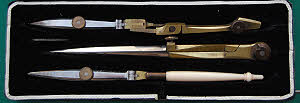
German set from the Biedermeier period (1815-48). Brass, ivory & steel, it has a black leatherette covered case.
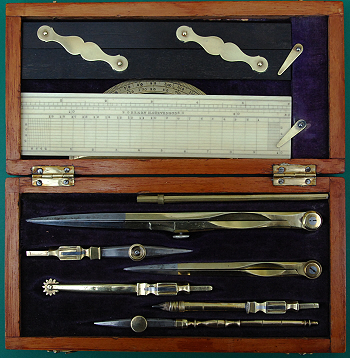
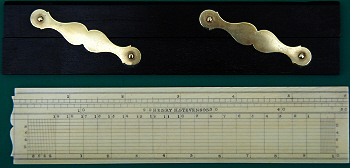
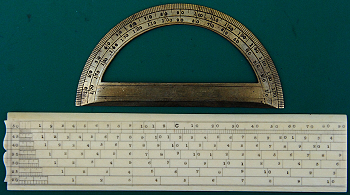
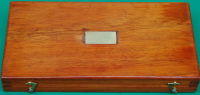
Not what it seems! At first sight this looks to be a set dating from the early nineteenth
century. However the box is comb jointed so cannot be earlier than late 19th century
although it was clearly made to fit the earlier instruments.
Closer examination reveals that the compass with its plain point, divider and crayon
holder are French. The compass has been adapted to take the earlier, English inserts
and has an English screw. The parallel rule, brass protractor, and ivory plain scale
are all English and the latter is signed “Henry H Stevenson”. Is he an unknown maker,
reseller, or owner? The box cartouche has been replaced so no clue there. These latter
three items could be early 19th century and part of an earlier set containing the
pen and the compass inserts.