










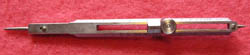


The purpose of a hydrometer is to determine the specific gravity of a liquid. From this it is often possible to determine the composition or strength of the liquid. The Sikes hydrometer was, for very many years, the standard means of determining the alcohol content of spirits and hence the duty payable. I have added gauging rules as they were also associated with determining the duty payable on wines and spirits.
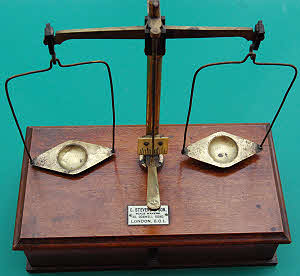
Two ounce class B beam scale by C Stevens & Son, Scale Makers, 58 Boswell Road, London EC1. It has “H M Govt” on the raising lever. It can be dismantled and placed in the box drawer. It has a selection of apothecary’s weights and there are two glass and one brass pans. The weights are mostly stamped with a crown over “GR” and the year below (mostly 36 to 38) indicating that the balance dates from the 1930s.
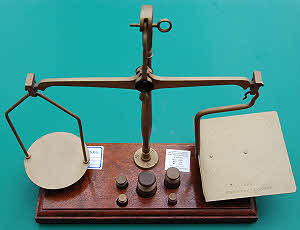
A GPO letter scale made by De Grave & Co, London and refurbished (twice) by the Wiltshire Scales Co. Metric with 100g, 50g, 20g and two 10g weights (there should be one 10g and two 20g). Last refurbished in 1999 it was then intended for weighing airmail letters. The scales may originally have been for imperial measurements and had imperial weights. The weights present all have different dates and two are stamped Turier (maker?)
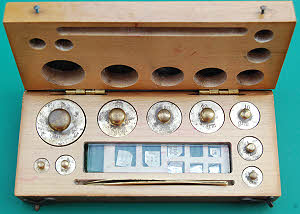
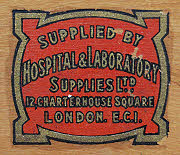
A set of metric weights dating from the mid 20th century and supplied by the firm whose transfer is on the lid. The brass weights run from 1g to 100g and the others from 10mg to 500mg.
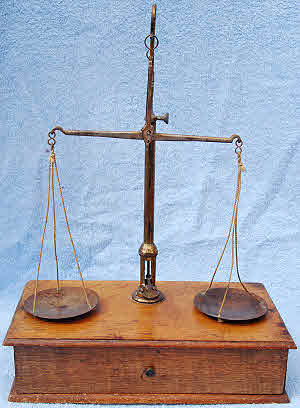
Cheap folding scale, probably for an apothecary. The beam is about 6 inches long and steel with swan-neck ends. The column, pans and other metal parts are brass. The base and drawer are crudely made from oak (visible parts) and pine (drawer sides, back and bottom, and box bottom). Ca.1900.
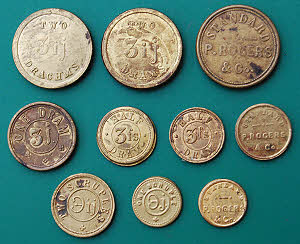
A set of apothecary weights by P Rogers & Co. There are three two drachm/dram weights, a one dram weight, three half dram weights, a two scruple weight, and two one scruple weights. Note that drachm is mis-spelt dram on all but the first example of the drachm weights. The obverse of each has the weight in word and symbol format and the reverse has Standard P Rogers & Co on it.
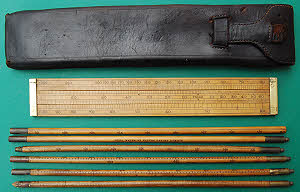
A set of six spile rods and a proof slide rule in a fitted leather case. The rods and slide rule are signed ‘Buss maker 33 Hatton Garden London’. The spile rods screw together to form a five foot dipping rod with inch and imperial gallon scales, that could be inserted through the spile hole in a bung. Thomas Odempsey Buss and his successors were at 33 Hatton Garden from 1865-1911.
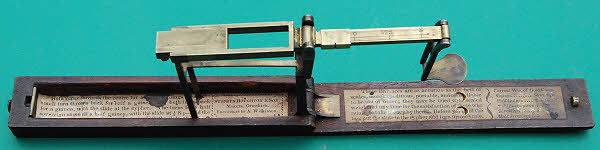
Self erecting coin scale by Stephen Houghton & Son, Makers, Ormskirk, Successors to A Wilkinson The left end of the beam has a turn over weight that is divided into two sections longitudinally. The right end has a sliding poise. The various combinations of positioning these allow the weights of guineas, half guineas and third guineas (seven shillings), sovereigns and half sovereigns to be checked. Ca. 1820. The paper in the left part of the box gives the instructions and that on the right part (lid) says they are accurate and gives the weights of each of these coins.


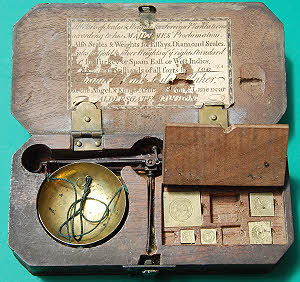
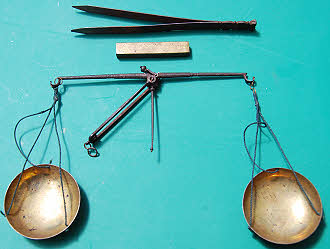
Assay or jeweller’s balance by Samuel Read dating from 1735-1748. Trade label states:
“All sorts of scales & weights for foreign Plantations according to his MAJESTIES ‘Proclamation. Also Scales & Weights for Essays, Diamond Scales, Scales for Gold & Silver, Weights of ye right Standard and Stilliards of all sorts by Samuel Read Scale Maker, at the Angel & Kings Arms, St Anns Lane near ALDERSGATE LONDON” The weights are for 2, 3, 8, 16 and 64 carats. Three weights are missing, presumably 1, 4 & 32 carats. The original tweezers for the weights are housed through a slot in the right hand side. (NB. The beam is upside down in the right hand photo. The function of the rectangular piece of brass is not known)
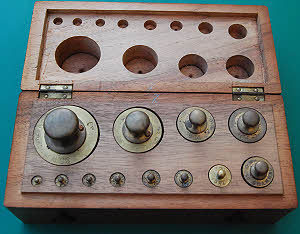
A set of brass weights from 1 to 500 grammes (sic) dating from the first half of the twentieth century. They are all stamped with a crown over the letter T except the 20 g weight that appears to be a replacement. They also have another stamp that appears to be a head facing left with the number “09” underneath. On the largest two weights this is stamped into a copper plug in the base of the handle. They were used by a chemist.

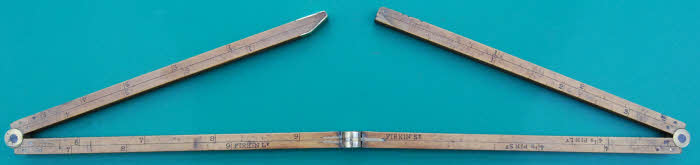
3 ft 4 fold dipping rod signed J Long Maker Eastcheap London. It is graduated for 5 sizes of cask, both lying and standing. These are the hogshead (54 gallons), barrel (36 gallons), kilderkin (18 gallons), firkin (9 gallons), and pin (4 1/2 gallons).
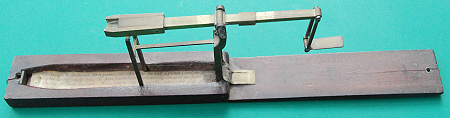
Self erecting guinea scale signed H Bell, Prescot, Lancashire. This scale is for
weighing guineas and half guineas only and has only a single turnover weight. The
sliding poise was used for determining how under-weight a coin was (and hence its
monetary value) if it had been clipped or was very worn. Probably ca.1800. Hamlet
Bell was working from 1781 to 1820 when he died.
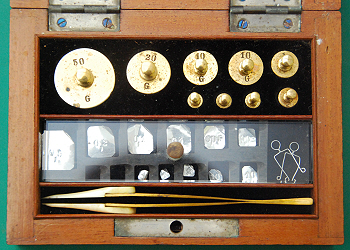
A fine set of metric chemistry weights in a mahogany box, engraved “No 244 Owen’s
College 1895”. The brass weights run from one to 50 grams, the aluminium ones from
1mg to 500mg. The tweezers are ivory tipped to avoid damaging the highly accurate
weights. The purpose of the two wire items is not known. There is also a chamois
leather outer case.




Metric dip rod made for Customs & Excise by Bentley & Taylor, London, possibly in
the 1970s. It is 1.2m long. One face is divided for diagonal line litres (i.e measurements
through the bung hole to the furthest corner), one face is divided for area litres
and the remaining two are divided for cm and 0.2cm.


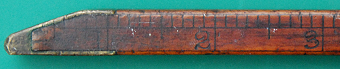

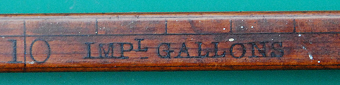

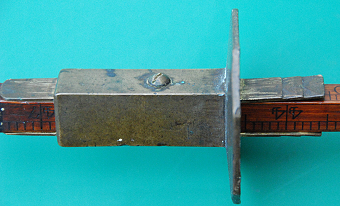
Bung rod made by Dring & Fage, London, Makers to the Customs. One face is divided
for Imperial Area, one face is divided for Imperial Gallons, and the remaining two,
opposite faces are divided for inches and tenths. It is 48 inches long. The sliding
collar enables its use for measuring the internal diameter of a cask. It has an old
repair with two brass plates spanning a break. It has been re-divided on the plates..
I have other rules that have been repaired in this way so that they could continue
to be used as they were quite expensive items. Late 19th or early 20th cntury.


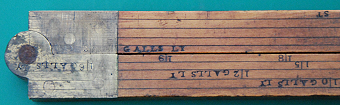
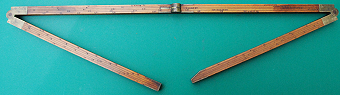

Dring & Fage three foot four fold dip rod made for the Customs & Excise. On one face
it is divided for Imperial Gallons to 100. On two faces it is divided in gallons
for various sizes of casks, both standing and lying. On the other face it is divided
for inches and tenths. Early 20th century.
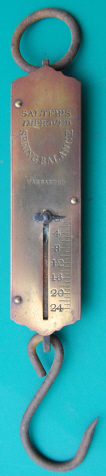
Salter’s Improved Spring Balance Warranted. This balance is for weights up to 24
pounds. It dates from the mid-20th century. In 1760 the brothers Richard & William
Salter established businesses manufacturing springs and pocket steelyards (spring
balances) in a cottage in Bilston, In 1769 the company was established. In 1825 George
Salter, a nephew of John Salter (son of Richard Salter) took over the firm and the
name became George Salter & Co and in 1838 took out the first of many weighing machine
patents. In 1953 the firm became a public limited company. In 1973 the company was
bought by Staveley Industries since when there have been further changes of ownership.
Salter balances of this type were made over a very long time period and are very
common still today. I inherited this one.



Set of four spile rods graduated in inches and Imperial gallons made by Cock of Broad
Street, London. He was working from 1830 to 1840. The case is very worn and may have
contained a slide rule as well. I have two slide rules by this maker on my Early
Slide Rules page
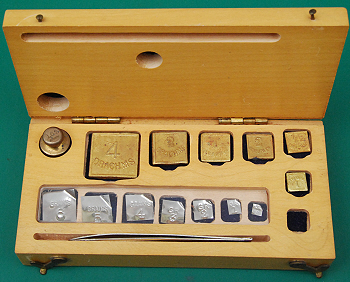
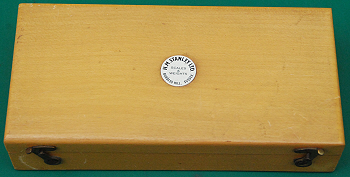
Boxed set of apothecary weights by H Stanley Ltd, Burgess Hill dating from the 1950s/60s.
Weights are:
1 to 6 grains, 1 & 2 scruples, 1/2, 1, 2 & 4 drachms and 1 ounce. Missing 1/2 scruple
weight.




Two foot four fold dipping rod for cylinder and bulge bottles by E Preston & Sons
graduated for quarts and gallons.